Living Trusts
What is a living trust?
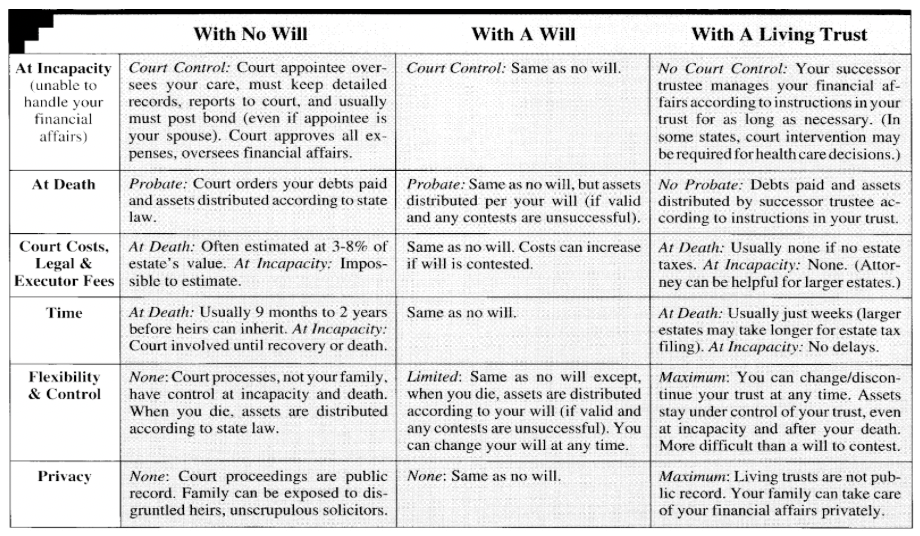
A living trust is a legal document that, just like a will, contains your instructions for what you want to happen to your assets when you die. But, unlike a will, a living trust avoids probate at death, can control all of your assets, and prevents the court from controlling your assets at incapacity.
What is probate?
Probate is the legal process through which the court sees that, when you die, your debts are paid and your assets are distributed according to your will. If you don’t have a valid will, your assets are distributed according to the state law.
I have a will. Why would I want a living trust?
Contrary to what you’ve probably heard, a will may not be the best plan for you and your family – primarily because a will does not avoid probate when you die. A will must be verified by the probate court before it can be enforced.
Also, because a will can only go into effect after you die, it provides no protection if you become physically or mentally incapacitated. So the court could easily take control of your assets before you die – a concern for millions of older Americans and their families.
Fortunately, there is a simple and proven alternative to a will – the revocable living trust. It avoids probate, and lets you keep control of your assets while you are living – even if you become incapacitated – and after you die.